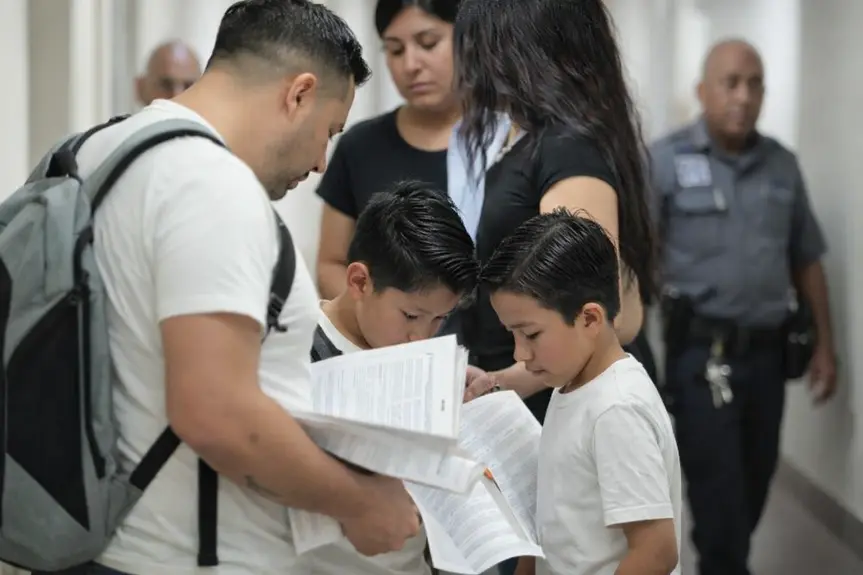
More than 24,000 immigrant children in the U.S., who arrived without a parent or guardian and are now facing deportation, could find themselves without legal assistance this week. A crucial federal contract that funds nonprofit legal services is set to expire, causing organizations to cut back or halt their support entirely.
This situation is further complicated by the Trump administration’s refusal to reimburse nonprofits for approximately $65 million for legal aid already provided to unaccompanied minors — funds these organizations believe they are owed under federal law. The expiration of this contract on Friday will impact around 90 organizations across the nation, including several operating within California.
Impact on Local Legal Aid Providers
Lindsay Toczylowski, director and co-founder of the Immigrant Defenders Law Center, which assists 13 facilities in Greater Los Angeles, expressed concern at a news conference on Wednesday about the impending cutbacks. Her organization currently supports over 1,500 unaccompanied children who will be directly impacted.
Other legal aid entities in the Los Angeles area, including Public Counsel, Central American Resource Center, and the Immigration Center for Women and Children, are also facing significant challenges due to this funding crisis.
Senator Ron Wyden noted troubling reports about the Trump administration fast-tracking the removal of over 500 migrant children, increasing the urgency of adequate legal representation for these vulnerable individuals. Toczylowski emphasized the critical role lawyers play as independent advocates in the immigration system, often acting as the only witnesses to ensure children’s rights are upheld amidst potential abuses and governmental failures.
National Ramifications and Legal Challenges
Across the nation, some organizations are being forced to conclude their legal services. Melissa Lopez from Estrella El Paso, which supports unaccompanied children in Texas and New Mexico, lamented the lack of legal resources in a region heavily populated by one of the largest detention centers in the U.S.
Meena Shah, managing director of legal services at a New York nonprofit, noted outstanding debts to her organization exceeding $2 million, raising concerns about the access to essential representation for families navigating the complex immigration process.
A federal judge in California previously mandated the government to cease using coercive tactics to urge immigrant children to self-deport, acknowledging the absurdity of expecting minors to represent themselves legally. The issues escalated in March when the Department of Health and Human Services canceled its contract with the Acacia Center for Justice, igniting a federal lawsuit against the Trump administration for allegedly violating the Trafficking Victims Protection Reauthorization Act.
This law was designed to ensure unaccompanied children receive legal counsel, shielding them from mistreatment and exploitation. Since its enactment, Congress has allocated significant funding to support this initiative. Despite a federal judge’s order to extend the contractual arrangements in June, the impending expiration raises alarms.
Nonprofits continue to face hardships as the government withholds reimbursements and demands sensitive client information, jeopardizing attorney-client privilege. Advocates claim these maneuvers aim to dismantle the legal support system for immigrant children, reflected in layoffs and service reductions.
Last month, the organization Kids in Need of Defense announced it would cancel its subcontract with Acacia Center due to over $20 million in unpaid fees. In response to the escalating crisis, U.S. Representative Zoe Lofgren recently reintroduced the Fair Day in Court for Kids Act, aiming to guarantee legal representation for unaccompanied minors in immigration court, a critical safety net for these children.
Toczylowski cautioned that eliminating legal support for such a vulnerable population should raise alarms among Americans. She highlighted that having legal advocates present in the courtroom is crucial for ensuring justice and preventing governmental misconduct within a flawed immigration system.